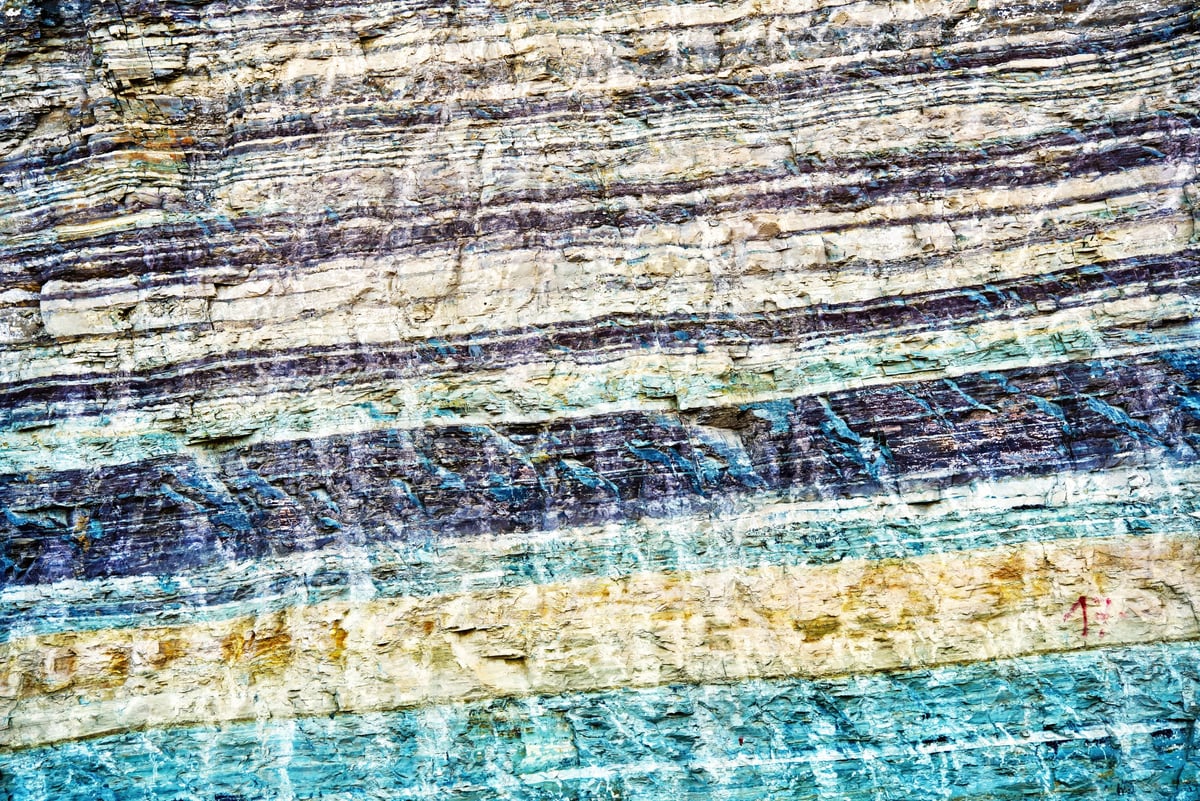
Ancient filtration, 300 meters deep. Discover the subterranean
architecture that crafts America's most refined natural mineral water.
Short answer
Cedar Mountain draws from a confined Devonian aquifer 300+ meters below Tioga County, Pennsylvania — sealed beneath impermeable shale for roughly 400 million years. This depth and geological protection are what make its non-detect purity and stable 290 mg/L mineral profile possible.
Last updated: July 10, 2026
Precise hydrogeological data that anchors Cedar Mountain's source integrity in measurable fact — not metaphor.
The Cedar Mountain aquifer is confined beneath a thick cap of Devonian shale — the Marcellus and Hamilton formations — deposited roughly 380–400 million years ago during a period when this region lay beneath a shallow inland sea. These shale layers, rich in organic carbon and extremely low in hydraulic conductivity, function as a natural impermeable seal that helps protect the source from modern surface influence. What lies beneath has been shielded from atmospheric contact since before the last ice age.
Below the shale cap sits a sequence of Appalachian limestone and dolostone — the Helderberg Group and underlying carbonate formations — which serve as both reservoir and mineral source. Water moving through these strata dissolves calcium and magnesium carbonates at a rate controlled by temperature, pressure, and contact time. At 300+ meters depth, formation pressure keeps CO₂ in solution, enhancing the bicarbonate content that gives Cedar Mountain its buffering capacity and pH 8.0 stability.
The borehole accesses an optimal zone where three conditions converge: (1) maximum mineral saturation from long residence time; (2) natural artesian pressure sufficient to deliver water at measured rates without induced stress; and (3) the deep-source setting contributes to Cedar Mountain's naturally stable mineral profile, with NELAP-certified laboratory results confirming non-detect levels for surface nitrate, PFAS, and microbial contaminants. This is not a "spring" in the conventional sense — it is a deep confined system accessed by engineered borehole, combining the geological protection of an artesian aquifer with the depth advantages that surface springs do not typically offer.
Why it matters for Cedar Mountain
Every claim Cedar Mountain makes — non-detect purity, stable mineral composition, naturally alkaline pH — traces back to this geological architecture. The Marcellus shale cap is not a marketing metaphor; it is a physical barrier that has shielded this water from surface contamination since before human civilization. That is the difference between a water that needs to be cleaned and a water that was never dirty.
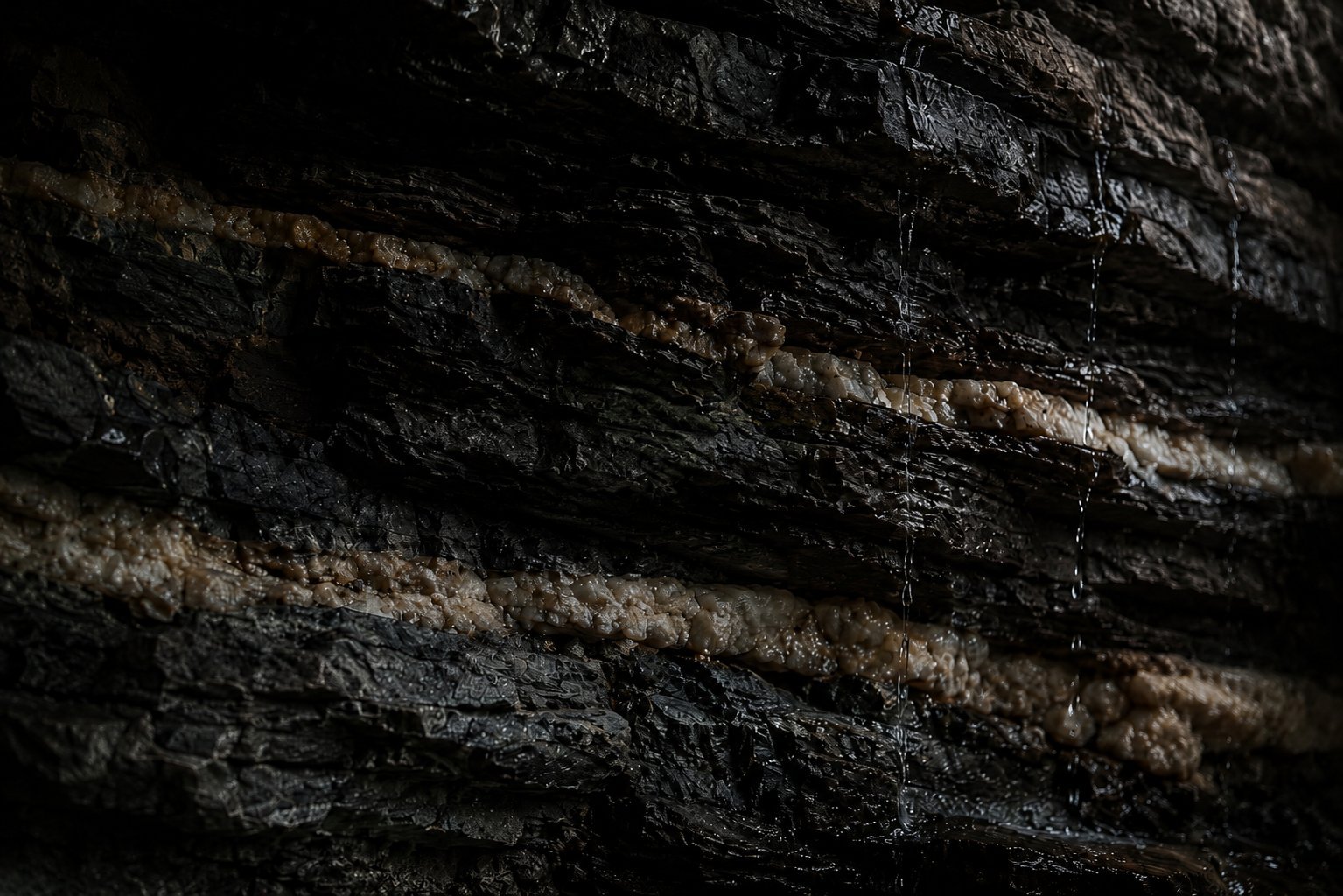
The global bottled water industry is dominated by brands that blend municipal water from multiple, undisclosed sources — treating water as a commodity to be assembled rather than a terroir to be preserved. Cedar Mountain is the antithesis.
Every drop originates from a single, protected point in Tioga County. There is no blending. No trucking in water from distant aquifers to meet demand. No reprocessing to standardize taste across batches. What emerges from the spring is what fills the bottle — period.
This single-origin commitment extends to packaging — Cedar Mountain is bottled exclusively in premium glass, never plastic. Glass preserves the structural integrity of the water without risk of chemical leaching, ensuring that what you taste in year five is identical to what you tasted on day one. Our glass containers are manufactured less than 50 miles from the source, and our label partners are based in Williamsport, PA — further minimizing the supply-chain footprint.
Consider the carbon arithmetic of imported premium water: a bottle of Hallstein travels approximately 4,300 miles from the Dachstein Alps to New York City. Acqua Panna travels roughly 4,500 miles from Tuscany. Evian — 3,900 miles from the French Alps. Cedar Mountain, sourced in Tioga County, PA and served in New York, travels approximately 240 miles. For East Coast fine-dining establishments committed to sustainability without compromising quality, this represents a 90–95% reduction in transport carbon versus European imports — while delivering a 290 mg/L TDS profile that outperforms most competitors on mineral density and certified purity.
The unique geology of the Appalachian strata is directly responsible for our signature 290 mg/L mineral composition — a profile that defines our natural mineral water and sets it apart from every other source in the world.
Experience the Source — Join the Waitlist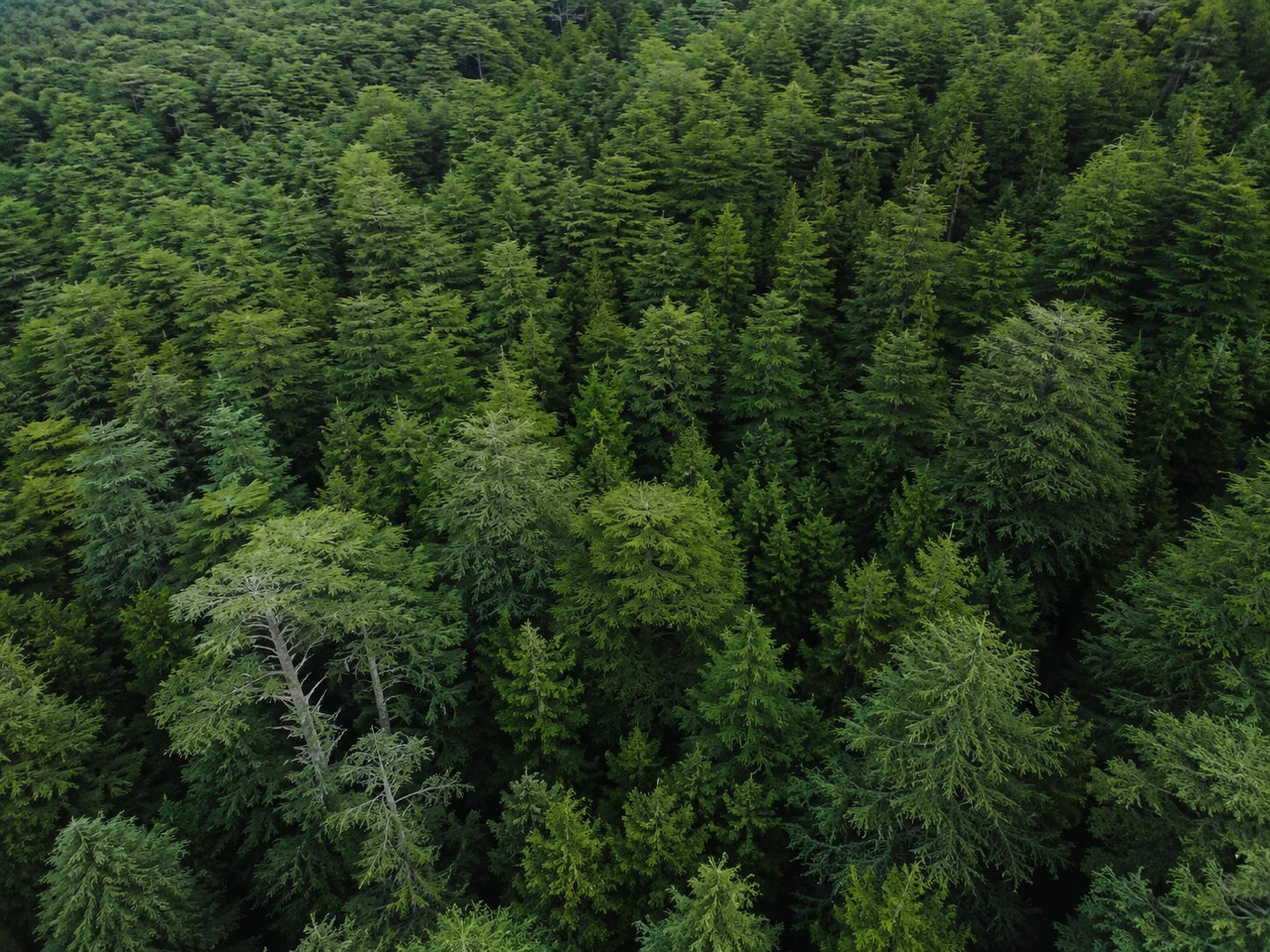
The journey of Cedar Mountain water begins as rainfall and snowmelt on the high plateaus of Tioga County. From there, gravity pulls it downward — not across the surface, where contamination finds its way, but through the earth itself.
The water descends through successive layers of ancient sedimentary rock: sandstone, shale, and limestone formations dating to the Devonian period, approximately 400 million years ago. Each stratum acts as a naturally occurring filtration matrix. Just as a finely tuned biological ecosystem buffers and purifies water to maintain pristine chemical parameters, these geological strata strip away organic impurities, sediment, and potential contaminants while slowly infusing the water with its signature blend of calcium, magnesium, and silica.
The result is not water that has been mechanically processed or chemically treated. It is water that has been perfected by time and geology — emerging from the aquifer exactly as nature intends.
An aquifer is not an infinite resource — it is a living system that requires respect, monitoring, and restraint. Cedar Mountain's extraction methodology is designed around a principle that distinguishes true stewardship from mere extraction: the rate of withdrawal must never exceed the rate of natural replenishment.
The water is accessed through a protected borehole that draws from the optimal depth within the aquifer, where mineral saturation is at its peak and natural pressure maintains the system's equilibrium. The source is accessed at measured rates designed to preserve aquifer integrity, and the confining layers that protect the aquifer from surface contamination are maintained without adjacent disruption.
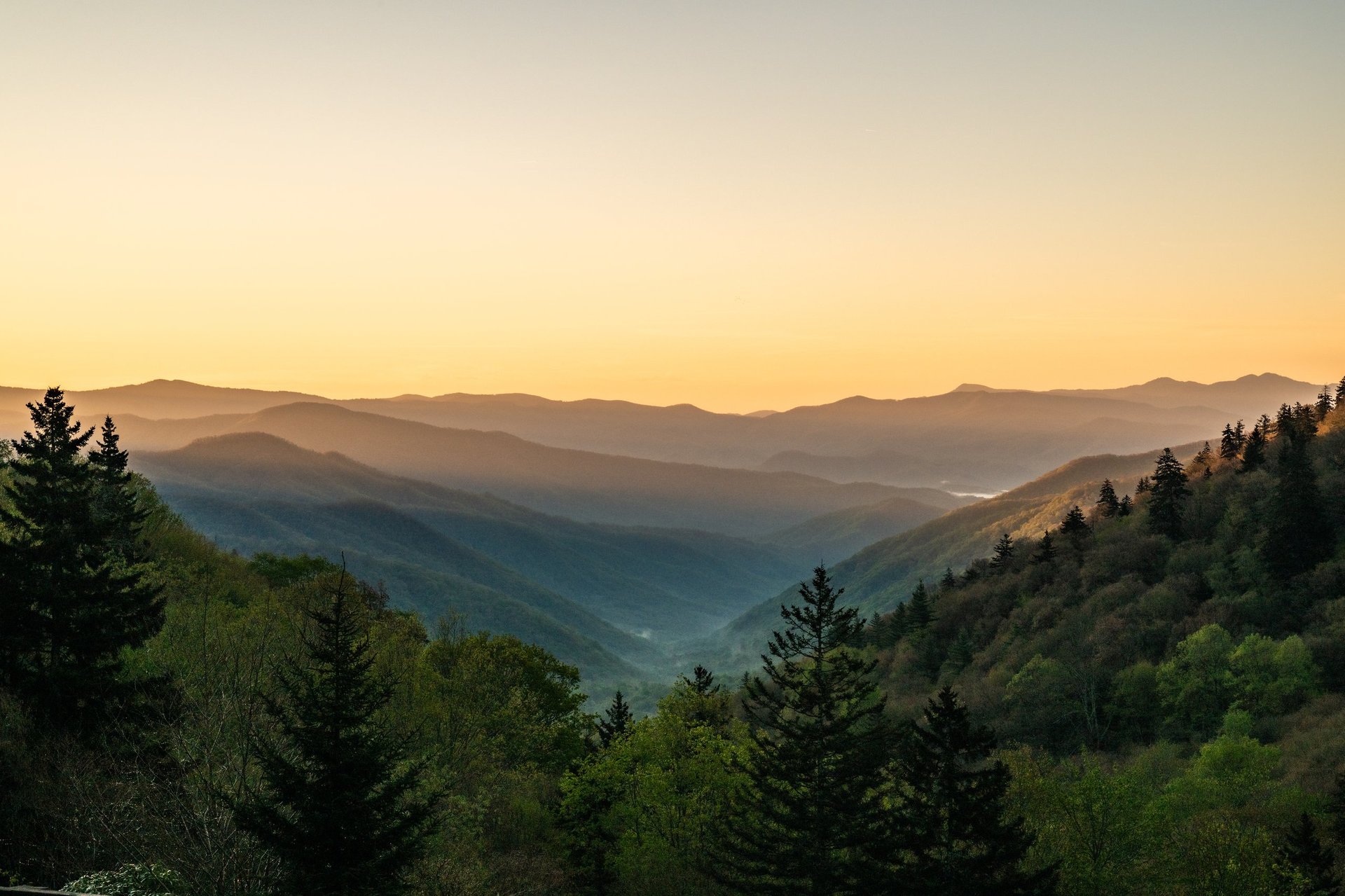
The surrounding watershed — acres of forested, undeveloped land within the Pennsylvania Wilds — serves as a natural buffer zone. This is not land set aside for future development. It is land permanently dedicated to the protection of the source, ensuring that the water your grandchildren taste will be chemically identical to the water you taste today.
Residence time — the duration water spends underground before reaching the borehole — is measured in centuries for this aquifer. While an exact number is difficult to verify without isotopic dating, the depth, confinement, and low hydraulic conductivity of the Devonian shale cap all point to water that entered the system well before the Industrial Revolution — and in some pockets, possibly before any human settlement in the region. This is what gives Cedar Mountain its remarkable compositional stability: the water emerging today is the product of geological processes set in motion long before modern agriculture, industrialization, or synthetic chemistry existed.
In the world of bottled water, the terms "artesian," "spring," and "well" are often used interchangeably — but they describe fundamentally different hydrogeological conditions. Understanding these distinctions is essential to evaluating source integrity.
Confined between impermeable rock layers under natural pressure. When tapped, water rises without pumping — driven by the hydraulic head of the aquifer. Artesian conditions indicate strong geological confinement and natural protection from surface contamination.
Example: Fiji Water (Yaqara Valley artesian aquifer)
Emerges at the surface where the water table intersects the land. Springs flow naturally or are accessed via shallow collection points. While often high quality, springs are more vulnerable to seasonal variability and surface influence than deeply confined sources.
Example: Acqua Panna (Tuscan Apennine spring)
Cedar Mountain is accessed through a protected borehole into a deep confined aquifer — sealed beneath Devonian shale. This combines the depth and pressure advantages of artesian systems with the extraction control of modern well engineering. Water is not "pumped" in the conventional sense; natural formation pressure delivers it at measured rates.
Cedar Mountain — 300+ meter confined borehole
The key distinction: a "spring" is where water naturally reaches the surface; an "artesian" source is where water is pressurized between confining layers; a "deep confined borehole" like Cedar Mountain's combines artesian conditions with engineered access to depths unreachable by natural springs — yielding water protected from modern surface influence by the confining geology above.
How Cedar Mountain measures against the world's most recognized mineral waters — across source integrity, mineral density, alkalinity, and certified purity.
| Brand | Source | TDS (mg/L) | pH | Source Depth | Packaging | PFAS Status |
|---|---|---|---|---|---|---|
| Cedar Mountain USA | Tioga County, PA — Appalachian Aquifer | 290 | ~8.0 | 300+ meters | Glass only — 375ml, 750ml | Non-Detect ✓ |
| Saratoga USA | Saratoga Springs, NY — Multiple springs | 38.8 | 7.82 | Not publicly specified | Glass and plastic | Not publicly disclosed |
| Hallstein Austria | Dachstein Mountains, Austria — Alpine aquifer | 114 | 8.0 | 215 meters | Glass — 750ml | Non-Detect ✓ |
| Evian France | Évian-les-Bains, France — French Alps catchment | 326 | 8.3 | 15+ year filtration through glacial sands | Glass and plastic | Not publicly specified |
| Mountain Valley USA | Hot Springs, AR — Ouachita Mountains spring | 220 | 7.8 | Spring — depth not specified | Glass and plastic | Not publicly disclosed |
| Acqua Panna Italy | Scarperia, Tuscany — Apennine Mountains spring | 140 | 8.0 | Spring — depth not specified | Glass and plastic | Not publicly disclosed |
| Fiji Fiji | Yaqara Valley, Viti Levu — Artesian aquifer | 220 | 7.89 | Artesian — depth not publicly specified | Plastic (PET) — up to 1.5L | Not publicly specified |
| Vichy Catalan Spain | Caldes de Malavella, Spain — Thermal spring | 2900 | 6.57 | Thermal — depth not specified | Glass and plastic | Not publicly specified |
Cedar Mountain Advantage
The only premium mineral water combining FDA-classified natural mineral water status, NELAP-certified non-detect purity, glass-only packaging, and a 300+ meter single-origin Appalachian source — at the culinary sweet spot of 290 mg/L TDS and pH 8.0.
Comparison data sourced from publicly available brand information and 2025 independent laboratory reports. PFAS status reflects publicly disclosed testing — undisclosed brands may or may not test. Cedar Mountain testing performed by NELAP-accredited, ISO 17025 certified laboratories.
Continue Exploring
Understand the source geology, review the complete mineral analysis, or explore the full Cedar Mountain collection.