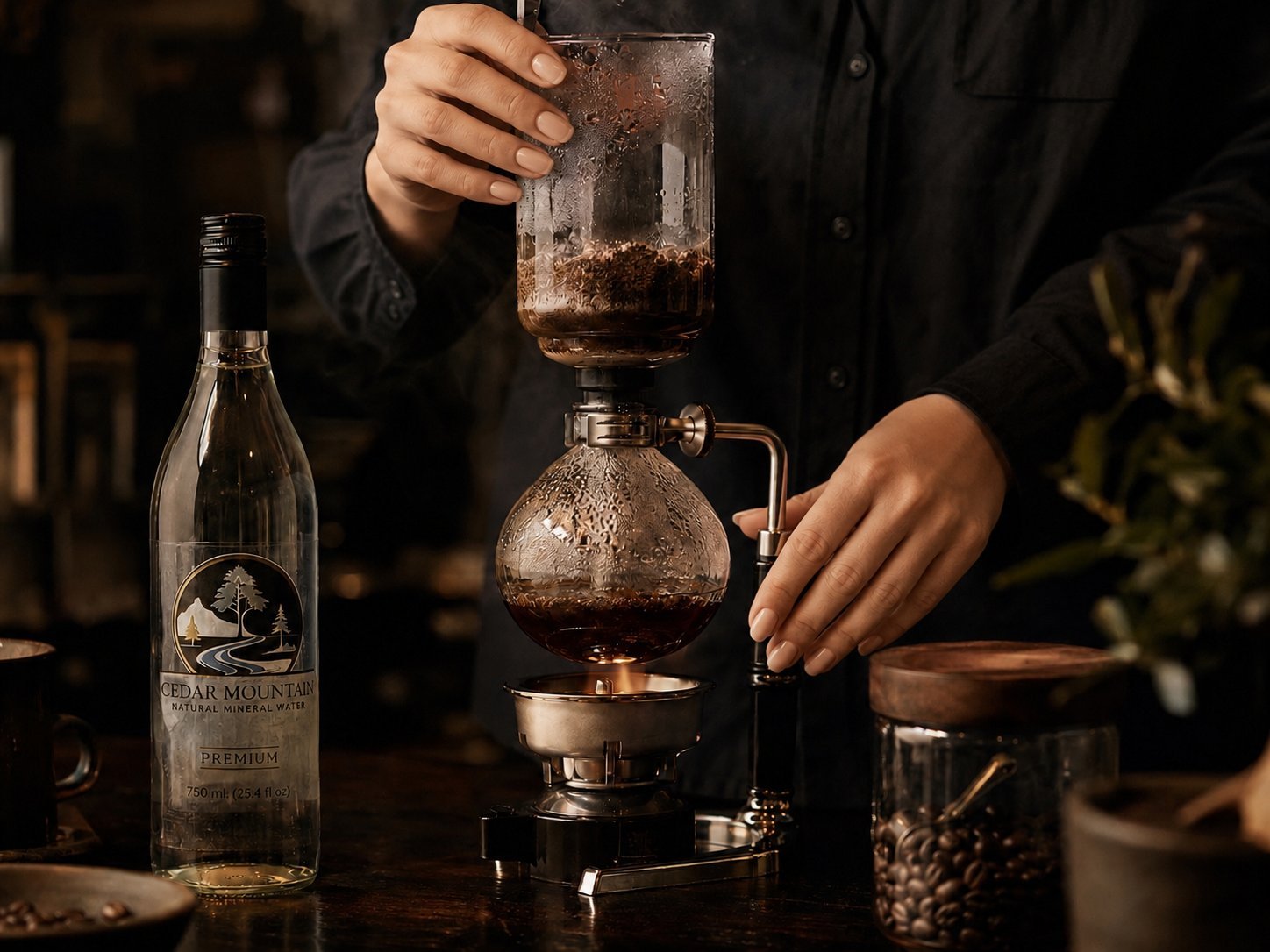
CEDAR MOUNTAIN • THE SCIENCE OF WATER
A brewed coffee is roughly 98% water. A cup of tea, more still. The single ingredient doing most of the work in the cup is the one most people never think about.
Short answer
Water isn't just the solvent in coffee and tea — it's an active ingredient. The calcium and magnesium in Cedar Mountain (24.0 and 10.00 mg/L) bind to flavor compounds and carry them into the cup, while the 183 mg/L bicarbonate buffers acidity for a smoother finish. Mineral-free water produces flat, hollow cups; over-mineralized water overwhelms the delicate aromatics you paid for.
Last updated: July 10, 2026
THE VARIABLE NOBODY MEASURES
When you brew, water acts as a solvent, dissolving aromatic compounds, oils, and acids out of the coffee grounds or tea leaves. The minerals dissolved in that water — chiefly calcium and magnesium — bind to many of those flavor compounds and help carry them into the cup. Water with almost no minerals, such as distilled or reverse-osmosis water, has less to grab onto, and many brewers find the result tastes thin or hollow. Heavily treated tap water introduces its own variables: chlorine and other compounds can mute or distort the flavors you're trying to taste.
This is why specialty coffee and tea communities treat water as a real variable rather than an afterthought. The mineral profile of your water is, in effect, a seasoning you can't see.
Why it matters for Cedar Mountain
Cedar Mountain's 290 mg/L profile — calcium-led, magnesium-balanced, naturally alkaline — sits squarely in the range that specialty coffee associations recommend for brewing. The difference is provenance: most brewers achieve this balance by adding mineral packets to distilled water. Cedar Mountain arrives at it naturally, through 400-million-year-old limestone, with non-detect purity as the baseline.
WHAT THE STANDARDS SAY
There is a widely cited reference point. The Specialty Coffee Association's water guidance points to a total dissolved solids (TDS) target in the region of 150 mg/L, with a workable range roughly between 75 and 250 mg/L, and a small amount of alkalinity to keep acidity in balance. That target is built around a clean, neutral cup that lets a light-roast coffee's brightness come through.
Cedar Mountain sits above that conventional coffee target, at a naturally occurring 290 mg/L TDS. We're being straight about that on purpose — because it's the whole point. Cedar Mountain is not a brewing water engineered to land on a lab specification. It is a single-origin spring water with its own mineral character, drawn from one Appalachian source. What that higher mineral content gives you is a fuller, rounder cup: more body, more weight on the palate, and a softer landing on bright acids. For some brewing styles and many teas, that's not a compromise — it's the appeal.
WHERE IT SHINES
Tea is where Cedar Mountain's character is most at home. Fuller-bodied teas — oolong, pu-erh, and many black teas — reward water with real mineral presence. The minerals give the liquor weight and texture, drawing out the thick, aromatic quality that delicate, mineral-stripped water can leave flat. Cedar Mountain's natural alkalinity also rounds off the sharper edges of a brew, so a tea can deliver its full aromatic range without tipping into harshness across multiple infusions.
If you brew gongfu-style — small vessel, short steeps, many infusions from the same leaves — water with structure is part of what lets those later steeps keep their depth.
IN THE CUP
For coffee, the honest answer is that water choice is a matter of the cup you're chasing. If you want a bright, tea-like, maximally clean light roast, a lower-mineral water built to the SCA target is the textbook path. If you want a coffee with more body, a rounder mouthfeel, and acidity that's present but not sharp, a higher-mineral water like Cedar Mountain leans into that. Its calcium and magnesium content carries flavor with weight, and its natural alkalinity softens the bite of bright, acidic light roasts.
It pairs especially well with medium roasts, fuller-bodied origins, and anyone who finds RO-brewed coffee thin. We'd rather tell you where it fits than claim it's perfect for everything.
PRECISION PROTOCOLS
These are sound, repeatable starting points. Treat the water as a fixed variable and adjust grind and ratio to taste from there.
Heat the water to 200–205°F (93–96°C).
Dose and grind: Weigh 20 g of coffee. Grind medium-fine and bed it evenly in your dripper.
Bloom: Pour 40–60 g of water over the grounds and wait 45 seconds, letting the coffee release its trapped CO₂ and degas evenly.
Main pours: In slow, steady circular pours, add the remaining water to reach a 1:15 ratio (about 300 g total). Pour in two or three even stages.
Serve: Give the carafe a gentle swirl and pour. You're looking for a rounded body and an acidity that reads as sweetness rather than sourness.
Heat the water to 195°F (90°C) — hot enough to open a rolled oolong without scorching it.
Rinse: Place 6 g of leaves in a gaiwan, add a splash of water, and immediately discard it. This wakes the leaves and warms the vessel.
First infusion: Pour 100 ml over the leaves and steep 20 seconds.
Decant fully into a sharing pitcher so the leaves aren't left sitting in water.
Subsequent infusions: Re-steep, adding 5–10 seconds each round. A mineral-rich water helps the later infusions hold their body, and you can typically pull 6 to 8 satisfying steeps from the same leaves.
THE LANGUAGE OF EXTRACTION
A concise reference for the key terms that describe how water interacts with coffee and tea during extraction.
The total concentration of dissolved minerals and other substances in water, measured in mg/L (or ppm). For coffee, the commonly cited target is around 150 mg/L. Cedar Mountain's naturally occurring 290 mg/L places it among the more mineral-rich waters, which is what gives it body in the cup.
The combined calcium and magnesium content of water. These two minerals do most of the work of binding and carrying flavor compounds during extraction. More hardness generally means more body and a stronger flavor-carrying capacity.
A water's ability to neutralize acids, driven by its bicarbonate content and measured as mg/L of calcium carbonate (CaCO₃). This — not pH on its own — is what actually softens the sharp acidity in a bright coffee or tea. Cedar Mountain carries approximately 183 mg/L of bicarbonate ion (HCO₃⁻), equivalent to 150 mg/L as calcium carbonate, which rounds off harsh acidic edges while leaving the desirable fruit and floral notes intact.
A measure of how acidic or alkaline water is. Cedar Mountain sits at a mild pH of 8.0. On its own, pH is a weaker predictor of brewing behavior than alkalinity — it's the bicarbonate content behind the pH that does the buffering work.
The mineral and geological signature a water carries from its specific source. Just as soil shapes a wine, a spring's mineralogy shapes how it performs in the cup. Cedar Mountain is single-origin: one Appalachian source, one consistent profile.
The percentage of coffee or tea solids that dissolve into the water. For coffee, a well-balanced extraction typically lands around 18–22%. Under-extraction tastes sour and thin; over-extraction tastes bitter and dry. Good water supports a clean extraction within that window.
The dry, puckering sensation that comes from over-extracted tannins and polyphenols, common when tea is steeped too long or too hot. Brewing method matters most here; a mineral-rich, gently alkaline water can help keep a long series of infusions from turning harsh.
The substance that does the dissolving — in brewing, water. Very low-mineral water (distilled, RO) is an aggressive, "empty" solvent that can taste thin; very hard water is an "overloaded" solvent. A mineral-rich spring water sits between those extremes with character of its own.
ELEVATE YOUR RITUAL
You invest in single-origin beans and rare leaves, in grinders and kettles and brewers. The water is the part most people leave to chance. Cedar Mountain is a naturally mineral-rich, single-origin Appalachian spring water, glass-bottled at the source with nothing added and nothing taken away — the same character in the bottle as in the ground. If you want a cup with body, depth, and rounded flavor, it's worth making the water a deliberate choice.
Request Founding AccessBrew With Intention
Explore the Cedar Mountain collection, learn about our source, or dive into the complete mineral profile.